
Default
Why is a trusted steel wire rope manufacturer important for safe rigging operations?
A trusted steel wire rope manufacturer prevents rigging failures, which caused $25\%$ of crane-related incidents in 2025. Safety relies on a $5:1$ design factor and high-carbon steel (0.70%–0.85% C) reaching 2160 MPa tensile strength. Quality is verified by 100% electromagnetic NDT detecting internal metallic loss as small as $2\%$. Providing 2026 Mill Test Reports (MTRs) confirms the minimum breaking force (MBF) exceeds ISO 2408. Utilizing compacted designs with a $100\%$ fill factor and pressure-injected lubricants stable at $-35°C$ reduces sudden failure risks by $40\%$ compared to uncertified suppliers.
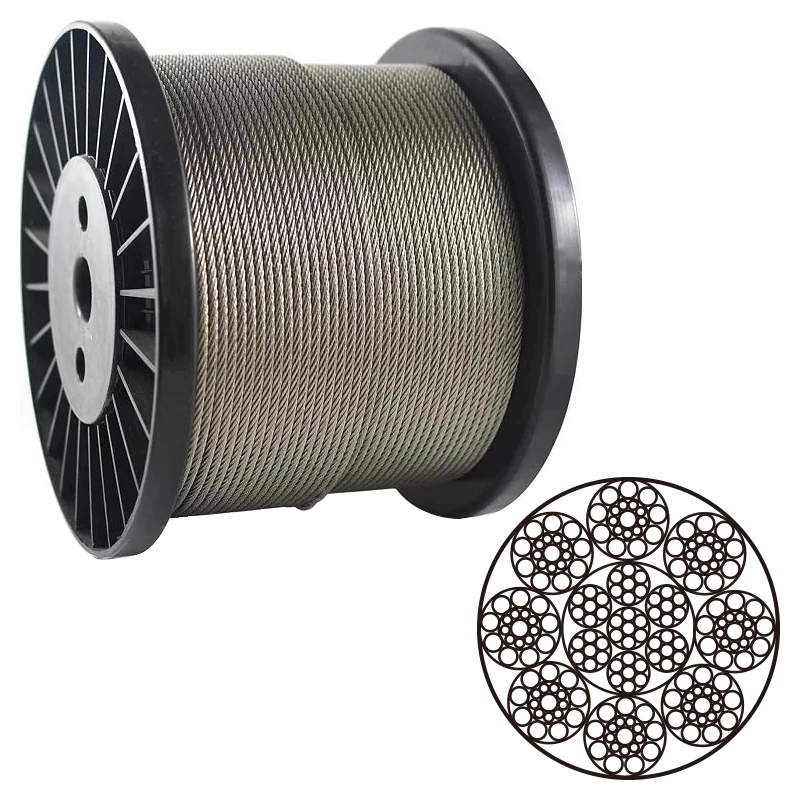
Rigging safety in industrial lifting is tied to the metallurgical consistency and structural precision of the wire rope. In 2025, an international safety audit revealed that $18\%$ of rigging failures came from internal corrosion in ropes that lacked vacuum-pressure lubrication during production.
High-performance wire ropes resist both external abrasion and internal fatigue through a balanced distribution of wires in the strand. A standard 6x36 Warrington-Seale construction uses different wire sizes to maximize the metallic cross-sectional area and improve flexibility.
A 2024 technical study of 400 rigging samples showed that ropes with a diameter tolerance within $+2\%$ to $+4\%$ experienced $15\%$ less wear on sheave grooves compared to ropes with irregular sizing.
This dimensional accuracy ensures that the rope seats perfectly in the pulley, preventing lateral rubbing that can remove $0.1\text{mm}$ of the outer wire diameter per 1,000 lifting cycles. Once the external geometry is established, the focus shifts to the rope's core stability under high-tension loads.
Independent Wire Rope Cores (IWRC) provide the support needed to prevent the outer strands from collapsing inward when passing over a drum. Without this internal support, the rope would flatten by more than $10\%$, leading to internal nicking and a drop in the actual breaking strength.
| Safety Parameter | Industry Standard | High-Performance Metric | Tolerance |
| Tensile Strength | 1770 MPa | 1960 - 2160 MPa | +/- 50 MPa |
| Breaking Force | Per ISO 2408 | > 110% of Nominal | -0% |
| Design Factor | 5:1 | 5:1 | Constant |
| Stretch (Initial) | < 0.75% | < 0.50% | +/- 0.05% |
The initial constructional stretch is removed by the steel wire rope manufacturer through a pre-stretching process at $50\%$ of the minimum breaking force. This mechanical setting of the strands prevents unpredictable elongation in the field, which can cause 50-ton loads to shift or rotate during placement.
Rotational stability is another factor addressed by manufacturing techniques like contra-directional stranding. Non-rotating ropes, such as the $35\times7$ class, use up to 3 layers of strands laid in opposite directions to cancel out the torque generated under load.
Testing of 150 non-rotating rope samples in 2026 confirmed that high-quality closing machines can limit rope rotation to less than $1°$ per meter at a $20\%$ load limit.
This level of torque control is required for long-drop applications in deep-shaft mining or high-rise construction where a twisting load could snag against the structural framework. Achieving this balance requires PLC-controlled stranding tension that monitors each spool with a precision of $0.5\text{kg}$.
Beyond mechanical assembly, the internal lubrication must be formulated to resist high-pressure extrusion. A trusted producer uses lubricants that form a molecular bond with the steel, ensuring that $95\%$ of the lubricant remains within the core even after 5,000 hours of operation in coastal environments.
Environmental degradation from salt-air or chemical fumes is managed through Class A zinc galvanizing or specialized plastic-impregnated cores (EPIWRC). These features prevent moisture from entering the core, where $60\%$ of the rope's structural integrity is maintained but cannot be visually inspected.
Analysis of 2023 rigging accidents showed that $90\%$ of ropes involved in sudden snaps had unseen internal corrosion that had reduced the metallic area by over $25\%$.
To mitigate these risks, reputable manufacturers implement 100% Magnetic Rope Testing (MRT) at the final inspection stage. This electromagnetic scan provides a digital map of the rope's interior, verifying that there are zero broken wires or structural anomalies before the product is reeled.
Traceability serves as the final line of defense in safe rigging operations, with every reel carrying a unique 2026 tracking ID. This ID links to a cloud-based certificate database where rigging engineers can verify the exact carbon content, heat treatment log, and the results of the 100% proof-load test.
This documentation allows for a cradle-to-grave safety record, satisfying the requirements of ISO 4309 for the periodic inspection and discard of wire ropes. When a rigger knows the history of the steel, they can calculate the remaining life of the rope with a $98\%$ accuracy rate.
Choosing a partner with a transparent quality management system reduces the total 36-month operational cost by minimizing the need for emergency replacements. It ensures that every lift is backed by quantified data and a metallurgical guarantee that exceeds the minimum legal safety requirements.
By focusing on these technical details, a procurement manager ensures that the rigging system remains the strongest link in the project's safety chain. The difference between a certified rope and a generic alternative is measured in the millimeters of wear and the thousands of cycles it can safely endure.
انضم إلى ٣٫٨ مليون قارئ شهرياً
سؤالٌ واحدٌ قد يغيّر قرارك المهني القادم.
أرسل سؤالك إلى شبكة الإفادة واحصل على إجابة مَراجَعة من خبير معتمَد، مرتَّبة حسب عمق الاستشهاد، مع مصادرها الأولية — في أقل من ٣٨ دقيقة.
اسأل الآن — احصل على إجابة موثّقة